
5 Powerful Ways Lean Lab in Smart-QC Drives Success
What Is Lean Lab in Smart-QC?
Lean Lab in Smart-QC represents the structured digital translation of lean laboratory principles into an automated scheduling engine.
As laboratories adopt lean laboratory management, a key challenge consistently emerges: how do you convert lean methodology into a scalable, reliable digital execution system?
Lean Lab in Smart QC provides that bridge.
Instead of relying on manual spreadsheets or isolated planning tools, Lean Lab in Smart-QC converts lean planning logic into structured scheduling processes that drive predictable, repeatable, and constraint-aware laboratory operations.
This ensures that lean design is not theoretical — it becomes operational reality.
Why Lean Laboratory Management Needs Digital Execution
Lean laboratory management focuses on:
- Flow efficiency
- Waste elimination
- Role clarity
- Standardized work
- Predictable cadence
However, sustaining lean maturity requires system enforcement.
Manual planning introduces variability.
Human adjustments create inconsistency.
Capacity misalignment leads to delays.
Lean Lab in Smart-QC embeds lean principles directly into a digital scheduling framework. This ensures operational discipline without relying on constant managerial oversight.
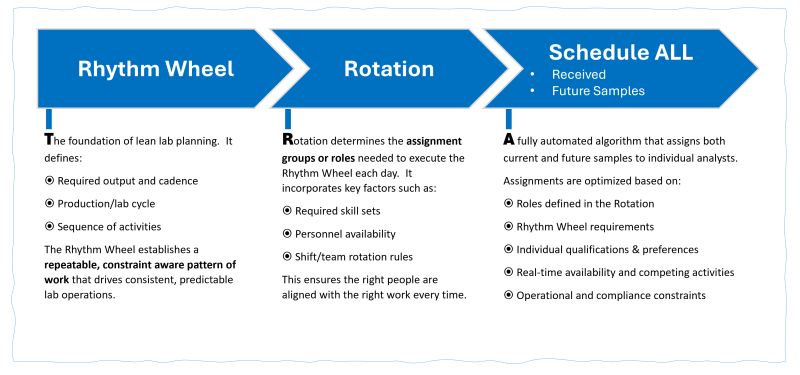
The 3 Core Processes Behind Lean Lab in Smart-QC
1. Rhythm Wheel in Lean Lab in Smart-QC
The Rhythm Wheel is the foundation of Lean Lab in Smart-QC.
It defines:
- Required output cadence
- Laboratory production cycle
- Standard activity sequence
- Capacity and constraint boundaries
The Rhythm Wheel creates a repeatable operational rhythm.
It stabilizes workflow.
It reduces unpredictability.
By digitizing this rhythm, Lean Lab in Smart QC ensures that planning is structured rather than reactive.
2. Rotation Structure for Workforce Alignment
Rotation determines the assignment groups required to execute the Rhythm Wheel each day.
It incorporates:
- Required skill sets
- Personnel availability
- Shift rules
- Team rotation policies
This ensures:
- The right analyst performs the right task
- Capacity aligns with demand
- Compliance constraints are respected
Lean Lab in Smart-QC removes guesswork from workforce planning and replaces it with structured role governance.
3. Schedule All Automation Engine
The Schedule All algorithm within Lean Lab in Smart QC automatically assigns:
- Current samples
- Future workload
- Individual analyst responsibilities
Assignments are optimized based on:
- Rotation definitions
- Rhythm Wheel cadence
- Qualifications and certifications
- Personal workload balancing
- Real-time availability
- Regulatory and operational constraints
Once master data is configured, Lean Lab in Smart QC continuously generates a lean-optimized execution plan.
This transforms lean planning into daily operational execution.
Benefits of Lean Lab in Smart QC
Organizations implementing Lean Lab in Smart QC experience measurable improvements:
- Reduced scheduling variability
- Improved analyst utilization rates
- Stronger compliance traceability
- Enhanced workload transparency
- Increased operational predictability
- Reduced firefighting behavior
Digital lean transformation requires more than documented procedures.
It requires algorithmic enforcement.
Lean Lab in Smart QC ensures that lean laboratory management becomes embedded in the operating system of the lab.
How Lean Lab in Smart-QC Prevents Execution Drift
Lean initiatives often fail due to execution drift.
Processes are designed correctly but gradually deviate due to workload pressure, staffing challenges, or changing priorities.
Lean Lab in Smart QC prevents drift by:
- Embedding lean logic directly into scheduling rules
- Enforcing structured cadence automatically
- Making capacity constraints visible
- Supporting data-driven adjustments
- Providing consistent workload distribution
This ensures lean laboratory management remains sustainable over time.
Strategic Impact of Lean Lab in Smart-QC
When lean principles are digitized, laboratories achieve:
- Predictable turnaround performance
- Better cross-functional coordination
- Lower operational risk
- Improved resource optimization
- Stronger compliance control
Lean Lab in Smart QC transforms lean methodology from a continuous improvement initiative into a permanent operational capability.
Conclusion
Lean Lab in Smart QC converts lean laboratory theory into automated, scalable operational control.
By integrating Rhythm Wheel planning, Rotation governance, and intelligent scheduling automation, laboratories achieve structured, predictable, and compliant performance.
To implement Lean Lab in Smart-QC in your laboratory operations, contact us to learn how Smart-QC can digitally enforce lean excellence.