
5 Critical Truths About Cycle Time vs OTD That Leaders Must Understand
Cycle Time vs OTD: Why the Metric You Prioritize Matters
Cycle Time vs OTD is one of the most misunderstood performance debates in laboratory and manufacturing environments. Many organizations shift focus toward improving On-Time Delivery (OTD) while gradually deprioritizing cycle time reduction.
At first glance, this appears reasonable. On-time delivery reflects customer satisfaction. However, the underlying operational reality is more complex.
Reducing cycle time delivers structural operational benefits that OTD alone cannot provide.
Why Cycle Time Is a Foundational KPI
Cycle time measures the total time required to complete a process from start to finish. It reflects process efficiency, capacity balance, and operational stability.
When cycle time is reduced, organizations experience:
- Lower work-in-progress (WIP) inventory
- Reduced finished goods holding
- Faster exposure of production deviations
- Earlier detection of quality issues
- Improved responsiveness to equipment failures
- Shorter overall lead times
Cycle time is therefore a structural health indicator of an organization’s operations.
In contrast, OTD measures schedule compliance — not process performance.
The Structural Weakness of OTD as a Standalone Metric
The core problem in the Cycle Time vs OTD debate is this:
You cannot sustainably improve OTD without improving cycle time, efficiency, and capacity alignment.
What often happens in practice?
Labs and supply chain teams collaborate and adjust due dates when deadlines are at risk. These adjustments are often justified:
- Resource constraints
- Equipment downtime
- Priority shifts
- Demand variability
However, each adjustment moves the target.
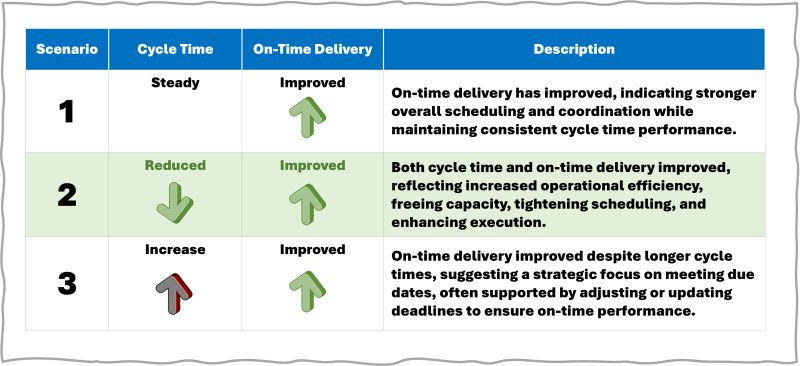
If a deadline is postponed, and the lab meets the new deadline, OTD appears high — even though the underlying process performance has not improved.
This creates a false sense of operational success.
The Moving Target Syndrome
When due dates are flexible, OTD becomes a moving performance indicator.
If cycle time remains long but deadlines are extended accordingly, OTD can remain artificially high. The metric reflects compliance with revised commitments rather than process efficiency.
This is why organizations relying solely on OTD often struggle with:
- Excess inventory
- Hidden bottlenecks
- Capacity imbalances
- Reactive firefighting
- Long lead times
The Cycle Time vs OTD discussion must therefore consider root-cause performance, not just delivery compliance.
5 Critical Truths About Cycle Time vs OTD
1. OTD Is an Outcome Metric
OTD measures whether commitments were met. It does not measure how efficiently the system operates.
2. Cycle Time Is a System Metric
Cycle time exposes bottlenecks, waste, and instability in the operational flow.
3. OTD Can Be Manipulated
Due dates can be revised. Cycle time cannot be “adjusted” without actual process change.
4. Shorter Cycle Time Naturally Improves OTD
When processes flow faster and more predictably, meeting commitments becomes easier without artificial adjustments.
5. Sustainable Performance Requires Both
Organizations must monitor cycle time, efficiency, and capacity metrics alongside OTD to prevent performance distortion.
The Strategic Approach to Balancing Cycle Time vs OTD
To properly manage Cycle Time vs OTD, organizations should:
- Define fixed due date governance rules
- Track original versus revised commitments
- Monitor cycle time distribution, not just averages
- Identify bottlenecks through capacity analysis
- Align KPIs across operations and supply chain
This ensures that OTD reflects true operational performance rather than flexible scheduling.
Conclusion
The debate around Cycle Time vs OTD is not about choosing one metric over the other. It is about understanding which metric drives sustainable operational excellence.
On-Time Delivery reflects customer commitment.
Cycle time reflects operational capability.
Organizations that prioritize only OTD risk masking structural inefficiencies. Those that focus on cycle time improvement build stronger, more resilient systems that naturally support reliable delivery.
To build a sustainable performance system that aligns Cycle Time vs OTD with true operational excellence, contact us to learn how structured KPI governance can transform your organization.