
4 Critical Batch Record Review Delays You Must Fix
Batch record review is the final control gate before a pharmaceutical product reaches the market.
Yet in many manufacturing environments, it quietly becomes the longest and least visible delay in the entire batch release process.
A batch may be technically “ready.” Testing may be complete. Documentation may appear finalized.
But without a formal release decision, product remains locked.
Every hour lost in batch record review affects:
- Patient access
- Distribution timelines
- Working capital
- Revenue realization
- Regulatory confidence
This is not simply a QA delay. It is an enterprise-wide operational risk.
Why Batch Record Review Becomes a Systemic Bottleneck
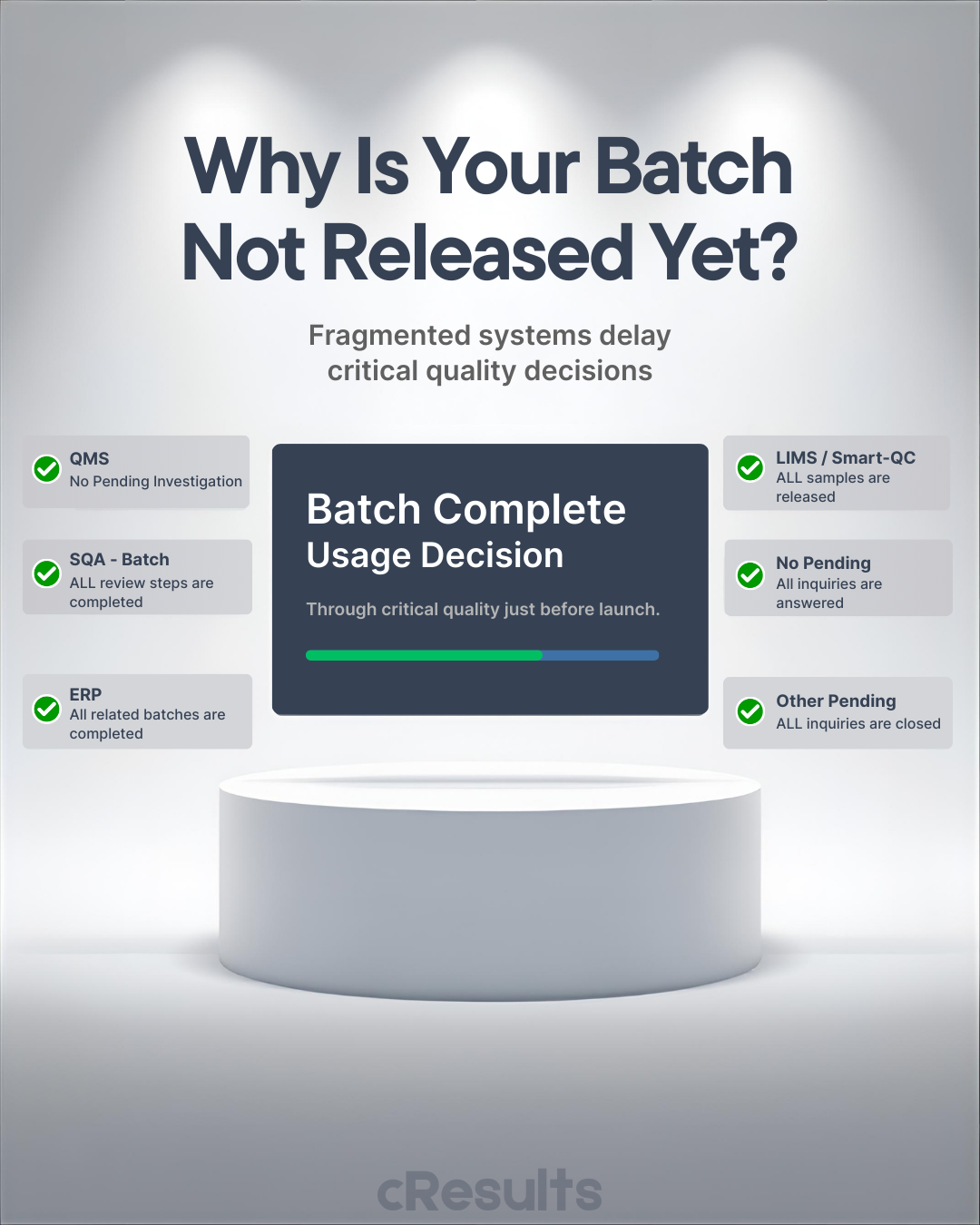
A compliant batch record review requires confirmation that multiple release-critical checkpoints are fully cleared.
These typically include:
- QMS – No open deviations or investigations
- ERP – All related production orders completed
- LIMS / Smart-QC – All analytical results approved
- SQA workflows – Review steps signed and verified
- Regulatory inquiries – No pending responses
- Change controls – Fully closed
Individually, these checkpoints seem manageable.
Collectively, across disconnected systems, they create friction.
When reviewers must log into multiple platforms and manually validate status, review becomes reactive instead of proactive.
4 Critical Delays in Batch Record Review
1. Fragmented Data Visibility
Release-critical information lives in separate tools.
QA teams often rely on:
- Emails
- Spreadsheets
- Manual follow-ups
- Informal confirmations
This increases review cycle time and audit exposure.
Without consolidated visibility, decision-making slows.
2. Investigation Dependency Lag
Even one open deviation can halt batch record review.
Common delay drivers:
- Late root cause analysis
- Pending CAPA approvals
- Awaiting cross-functional input
If investigation status is not tracked in real time, batches sit unnecessarily.
3. Undefined Ownership and Escalation
When task accountability is unclear:
- Reviews wait for signatures
- Queries remain unanswered
- Escalations are informal
This weakens pharma quality assurance governance.
Clear role definition is essential to accelerate the batch release process.
4. Lack of Performance Metrics
Many organizations measure manufacturing output.
Fewer measure batch record review cycle time.
Without KPIs such as:
- Average release turnaround time
- Deviation aging
- Review backlog volume
- QA approval time
delays become normalized.
What is not measured cannot be optimized.
How to Optimize Batch Record Review for Speed and Control
Improving batch record review does not mean reducing rigor.
It means improving orchestration.
Key improvement strategies include:
Centralized Release Dashboard
Create a single decision view consolidating:
- QMS status
- LIMS release confirmation
- ERP completion signals
- Workflow approvals
This eliminates manual cross-verification.
Configurable QA Workflow Automation
Automated workflows ensure:
- Task assignment clarity
- Defined review stages
- Escalation triggers
- SLA tracking
This strengthens QA workflow automation and reduces dependency delays.
Real-Time KPI Monitoring
Establish performance dashboards tracking:
- Release cycle time
- Blocked batch aging
- Investigation resolution rate
- Cross-functional response time
This transforms batch record review into a controlled, measurable process.
Proactive Blocker Identification
Instead of waiting for final review, enable early alerts when:
- Deviations approach aging thresholds
- Investigations remain pending
- Required data is incomplete
This prevents last-minute release shocks.
The Strategic Impact of Faster Batch Record Review
A streamlined batch record review delivers:
- Faster patient access
- Improved supply chain predictability
- Stronger inspection readiness
- Better working capital efficiency
- Higher executive confidence in QA
According to U.S. Food and Drug Administration (FDA) Pharmaceutical Quality System guidance, effective quality oversight requires transparency and documented control.
A delayed review signals systemic coordination gaps.
An optimized review reflects operational maturity.
Batch record review is not just a final checklist.
It is the convergence point of manufacturing, quality, regulatory, and business performance.
If your batch release process feels unpredictable, the root cause may not be production.
It may be review orchestration.
For deeper operational strategies, explore:
What is the biggest constraint slowing your batch record review today?
For smarter digital QA transformation with smart-Qa, contact us.