
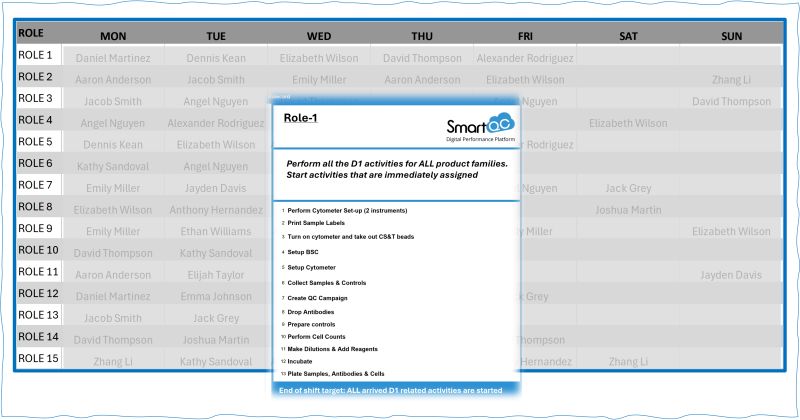
The key objective of QC laboratory role cards is to clearly define roles in alignment with the expected hands-on time and the manufacturing cadence, supporting repeatable patterns and production volume. QC laboratory role cards serve as a foundational tool for digital scheduling, workload distribution, and operational efficiency across quality control teams.
Below is a practical framework we recommend, based on the use of QC laboratory role cards in Smart-QC for digital scheduling.
Why QC Laboratory Role Cards Matter in Modern Labs
In high-throughput QC environments, undefined or overlapping roles lead to bottlenecks, missed SLAs, and inefficient use of analyst time. A well-structured QC laboratory role card eliminates ambiguity by anchoring each role to measurable outputs, decision rights, and cross-functional responsibilities.
Without proper role definitions, even the most advanced laboratory systems underperform. Role cards bridge the gap between scheduling intent and actual execution — particularly when integrated with tools like Smart-QC’s Projection Module and Auto-Rotation algorithms.
Key Focus Areas for Creating Effective QC Laboratory Role Cards
1. Align Role Purpose with Production Cadence
Clearly define the role purpose and align it with production cadence, leveraging the Smart-QC Projection Module. Each QC laboratory role card should reflect the actual throughput expectations of your manufacturing line — not a theoretical average.
2. Define Distinct, Shift-Filling Tasks
Define the role to include distinct, well-defined tasks that fill the majority of the shift. Vague task lists lead to analyst downtime and scheduling gaps. A strong QC laboratory role card accounts for both primary testing duties and secondary responsibilities such as instrument checks or documentation.
3. Establish Clear Decision Authority and Escalation Points
Clearly define decision authority and escalation points. Use Smart-QC to identify when a role is underutilized or when escalation thresholds are being triggered repeatedly — a signal that the QC laboratory role card needs refinement.
4. Use Measurable KPIs to Track Role Performance
Use measurable KPIs (efficiency and service level) from the 50+ KPIs available in Smart-QC. Each QC laboratory role card should reference the specific KPIs that will be used to evaluate role performance. This creates accountability and supports continuous improvement.
5. Enable Cross-Functional Collaboration
Enable cross-functional collaboration, especially with Manufacturing and QA. QC laboratory role cards should not exist in isolation — they must reflect the interdependencies between quality control, production scheduling, and quality assurance teams.
6. Leverage Smart-QC Auto-Rotation and Scheduling Algorithms
Use Smart-QC Auto-Rotation and scheduling algorithms to dynamically populate roles and actual samples. This ensures your QC laboratory role cards remain effective even as production volumes fluctuate or team composition changes across shifts.
7. Avoid Splitting Activities Across Multiple Roles
Avoid breaking activities across multiple roles to theoretically gain efficiency, as this often results in increased complexity and potential loss of efficiency. A well-designed QC laboratory role card keeps related tasks together to minimize handoff errors and cognitive load on analysts.
How Smart-QC Supports QC Laboratory Role Card Implementation
Smart-QC is purpose-built for digital QC scheduling and role management. Its Projection Module allows managers to model role utilization before deployment, while the Auto-Rotation engine dynamically assigns analysts based on live sample queues and predefined QC laboratory role card parameters.
Key Smart-QC capabilities that support role card implementation include real-time KPI tracking, shift-level scheduling visibility, automated workload balancing, and escalation alerts — all of which directly reinforce the structure defined in your QC laboratory role cards.
Common Mistakes to Avoid When Designing QC Laboratory Role Cards
Many labs make the mistake of designing QC laboratory role cards around headcount rather than workflow. This results in cards that look complete on paper but fail in practice during peak production periods. Other common pitfalls include:
- Defining roles too broadly, making it impossible to measure individual performance
- Ignoring shift-to-shift variability in sample volume
- Failing to update QC laboratory role cards as processes evolve
- Overlooking the input of frontline analysts who perform the work daily
Final Thoughts on QC Laboratory Role Cards
A structured approach to QC laboratory role cards is one of the highest-leverage improvements a QC manager can make. When roles are clearly defined, measurable, and dynamically supported by tools like Smart-QC, laboratories consistently achieve higher throughput, better SLA adherence, and improved analyst engagement.
Contact us for more information about Smart QC and how it can support your organization’s needs.