
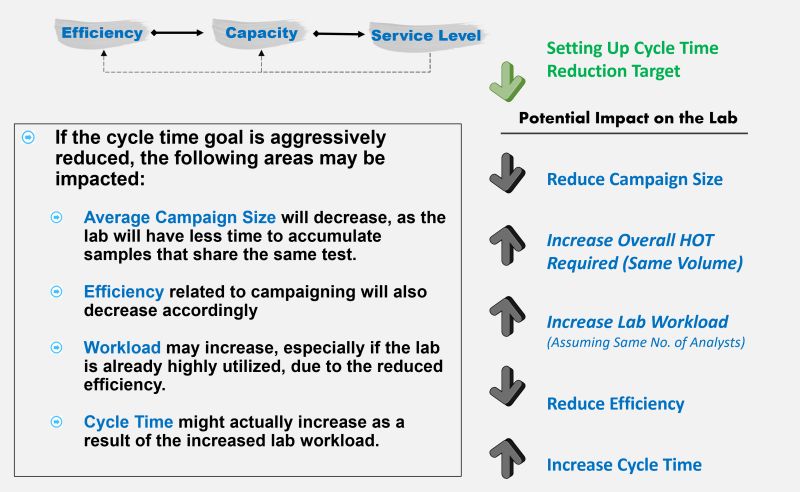
Customers often ask us about the best approach to managing cycle time using Smart-QC.
Previously, we discussed how to manage efficiency in QC labs and its relationship to cycle time. Before diving into cycle time reduction, we will first explore the relationship between efficiency, campaigning, and cycle time. These two factors—cycle time and efficiency—often conflict, typically leading to opposing outcomes. However, a balanced approach can help manage both effectively.
Key Insights
The element that connects both cycle time and efficiency is campaigning. Intuitively, batching more samples improves efficiency, but it also extends the overall duration before these samples are released or authorized.
A key function of Smart-QC is to manage the risk of delaying assignments to accumulate more samples, ensuring sufficient efficiency while still meeting cycle time targets (Service Level Goals). This optimization relies on various factors and techniques, including:
- Leveraging simulation to identify patterns and predict the likelihood of receiving additional samples.
- Monitoring the expected arrival of manufacturing lots/batches to assess upcoming campaigning opportunities in advance.
- Considering key attributes such as re-tests, test turnaround time, allocated testing time (test cycle time), and constraints like predecessor-successor dependencies.
- Calculating the efficiency curve to determine when additional batching no longer provides significant savings—indicating the optimal time to start testing.
By integrating these techniques, Smart-QC ensures that QC operations achieve both efficiency and the desired cycle times.
What’s Next?
In our next post, we will outline a structured approach to cycle time reduction.
Here are some basic principles we will expand on:
- Setting realistic and achievable cycle time goals at the product, sample type, and test levels, while measuring performance at the test, sample, and manufacturing lot levels.
- Capturing reasons for missed cycle time targets: If key milestones (e.g., critical tests) fail to meet cycle time goals, Smart-QC will prompt analysts to enter a reason. This data can then be analyzed to identify root causes and drive improvements.