
Customers often ask us about the best approach to managing efficiency using Smart-QC.
Below are key points and actionable steps to guide this process:
Efficiency improvement is a structured, ongoing process that requires daily, weekly, and monthly actions, along with constant monitoring.
Managing efficiency should be an integral part of your routine, supported by the consistent use of Smart-QC.
Smart-QC provides all the critical components for success, helping to manage lab efficiency and drive operational excellence:
It offers detailed business processes, KPIs, and tools tailored to improve lab efficiency.
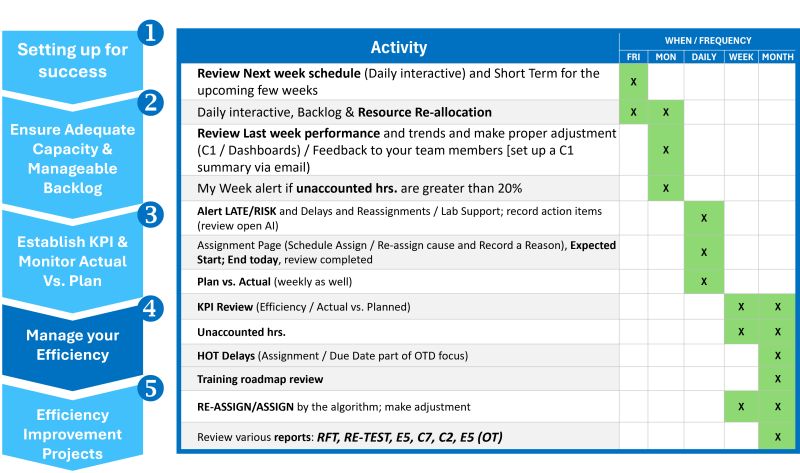
It provides guidance on specific activities to perform on particular days (e.g., Friday, Monday), as well as daily, weekly, and monthly routines. The illustration below highlights activities that promote behavioral change and improved efficiency. Achieving efficiency improvements in key performance indicators requires the engagement of top management and regular reviews of relevant KPIs.
Efficiency improvements can lead to increased output, improved service levels, and cost reductions. The included illustration highlights the key areas impacted by efficiency improvements.
Steps for Achieving Successful efficiency program leveraging Smart-QC
- Setting Up for Success: System Usage
Master Data:
Ensure standards (HOT) are accurate within a +/- 10-15% range.
Configure system settings appropriately.
Usage:
Record basic start/end times or integrate with automated systems.
Promptly log HOT delays. - Ensure Adequate Capacity & Manageable Backlog
Develop a campaigning strategy using reports and simulations.
Maintain a manageable backlog by freezing the schedule at least 2+ days in advance. - Establish KPIs Focused on Efficiency
For high-volume, testing-focused labs:
Track “Earned Hours per Analyst” as a key efficiency measure.
For lab support activities:
Focus on workload metrics. - Make Efficiency Management Part of Your Routine Daily Actions:
Use the Assignment Page to plan and monitor tasks.
Confirm expected start and end times for activities.
Resolve alerts for daily issues and monitor the backlog.
Review Actual vs. Plan (execution).
Weekly Actions:
Analyze weekly efficiency metrics (e.g., efficiency and earned hours).
Focus on cross-training to reduce imbalances. - Implement Efficiency Improvement Projects
Focus on eliminating waste in the following areas:
Address HOT delays.
Rationalize lab support activities.
Optimize unavailable time management.
Create Centers of Excellence for non-testing activities (e.g., Technical vs. Chemist roles).
By following these steps and leveraging Smart-QC, you can drive meaningful improvements in efficiency and achieve operational excellence.