
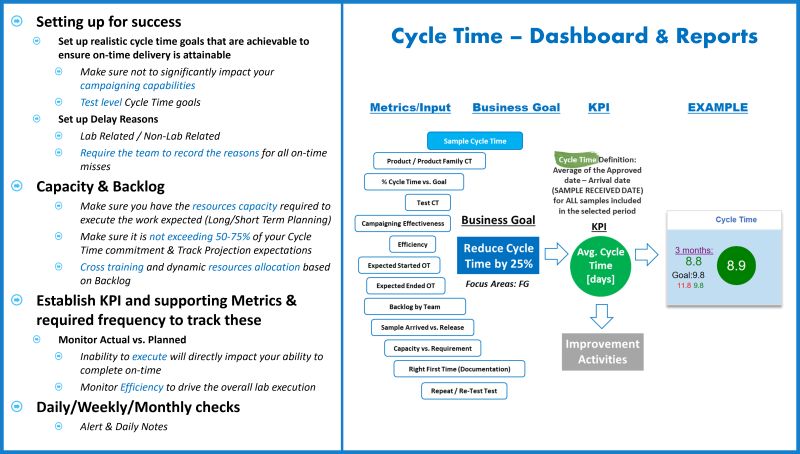
Customers often ask us about the best approach to managing cycle time using Smart-QC. Previously, we discussed the relationship between cycle time, campaigning, and efficiency.
This time, we will dive into steps for managing and improving overall cycle time while ensuring efficiency is maintained and gradually enhanced.
Key Steps to Managing Cycle Time
- Setting Up for Success
To effectively manage cycle time, it is essential to configure all relevant master data in Smart-QC accurately, ensuring alignment with business needs and compliance with the service level agreement (SLA) with the supply chain.
Set Realistic Cycle Time Goals- Ensure goals are achievable to support on-time delivery.
- Avoid significantly impacting your campaigning capabilities—reduced campaigning can decrease efficiency and increase backlog, leading to the opposite of the intended goal.
- Define test-level cycle time goals—some tests may be more critical to complete earlier due to factors like re-testing. Smart-QC automates this process, but additional inputs can further enhance results.
- Set Up Delay Reasons If delays occur, users will be required to enter a reason, improving overall accountability. Categorize delays as Lab-Related or Non-Lab-Related for better differentiation.
- Require teams to record reasons for all on-time misses.
- Capacity & Backlog Management
Attempting to expedite cycle time without adequate capacity can increase backlog and extend cycle times instead of improving them. It is crucial to assess capacity and flexibility before initiating a cycle time reduction strategy.- Ensure sufficient resource capacity to meet workload expectations (long-term and short-term planning).
- Avoid exceeding 50–75% of your cycle time commitment and track projection expectations.
- Implement cross-training and dynamically allocate resources based on backlog.
- Establishing KPIs and Metrics
No improvement program can be effective without well-defined KPIs and tracking mechanisms.- Monitor Actual vs. Planned Performance
- Inability to execute as planned will directly impact on-time completion.
- Track efficiency to optimize overall lab execution.
- Regular Performance Checks
Do not wait until the end of the process to realize a manufacturing lot or sample has missed its goal. Use Smart-QC reports and dashboards for proactive tracking.- Conduct daily, weekly, and monthly checks to stay ahead.
- Utilize alerts and daily notes to maintain visibility and responsiveness.