
7 Proven Strategies to Improve Lab Efficiency and Cycle Time
The Hidden Conflict Between Lab Efficiency and Cycle Time
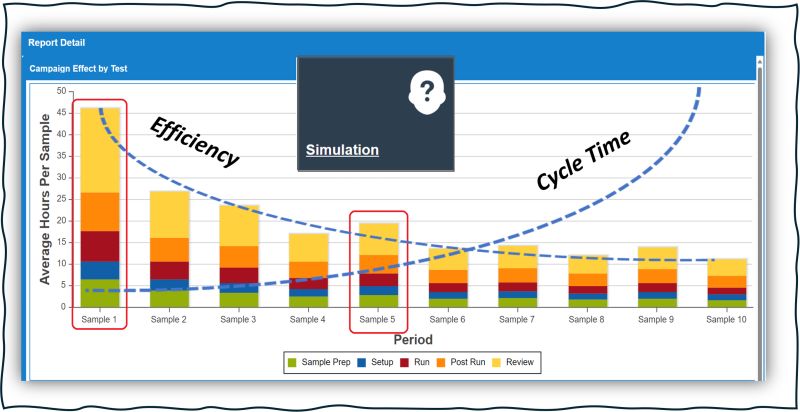
Lab efficiency and cycle time are two of the most critical performance metrics in laboratory operations. Every lab manager wants to improve both. However, in real-world operations, improving one often negatively impacts the other.
In laboratory environments, batching samples into campaigns improves efficiency. Whether a run processes one sample or twenty, the same fixed activities are required:
- Sample preparation
- Equipment setup
- Instrument warm-up
- Calibration
- Method verification
- Result analysis
- Reporting
Because these fixed activities consume time regardless of volume, adding more samples increases only incremental time while keeping the fixed cost constant.
The operational result is clear:
Larger campaigns increase lab efficiency.
However, this introduces a serious tradeoff.
Why Efficiency and Cycle Time Compete
To maximize lab efficiency and cycle time performance, laboratories often delay processing until enough samples accumulate to justify a full campaign.
But waiting increases turnaround time.
This creates a structural operational dilemma:
- Wait longer → Higher efficiency
- Run sooner → Lower cycle time
If labs wait too long, customer satisfaction drops.
If labs run too early, cost per sample increases.
Balancing lab efficiency and cycle time is therefore not a scheduling decision. It is a strategic optimization challenge.
Why Traditional Lean Thinking Falls Short
Lean manufacturing promotes single-piece flow — processing items immediately as they arrive. While this works in some production environments, laboratories operate under different constraints.
In lab operations:
- Equipment utilization matters significantly
- Analytical instruments require setup cycles
- Campaign preparation consumes fixed time
- Regulatory documentation adds overhead
Running every sample immediately may reduce cycle time slightly, but it can dramatically reduce overall lab efficiency.
Therefore, laboratories require a more nuanced batching strategy rather than pure single-piece flow.
7 Proven Strategies to Balance Lab Efficiency and Cycle Time
1. Define a Minimum Viable Campaign Size
Establish the smallest batch size that maintains acceptable efficiency levels without excessive waiting.
2. Set a Maximum Waiting Threshold
Define a time limit after which samples must be processed, even if optimal batch size is not reached.
3. Forecast Expected Sample Volume
Predicting incoming workload improves decision-making. Even limited visibility reduces uncertainty.
4. Use Simulation Modeling
Simulation allows teams to evaluate how different campaign sizes affect both efficiency and cycle time before making operational changes.
5. Apply Intelligent Business Rules
Examples include:
- Fixed batching days
- Shift-based thresholds
- Priority override for urgent samples
6. Identify the Efficiency Inflection Point
There is a point where waiting longer no longer produces meaningful efficiency gains. Identifying this threshold prevents unnecessary delays.
7. Align Expectations with Customer Service Agreements (CSAs)
Clear service level definitions ensure that batching logic supports business commitments.
The Data-Driven Approach to Lab Efficiency and Cycle Time
Instead of relying on intuition, laboratories should measure:
- Equipment utilization rates
- Campaign setup time
- Incremental processing time per sample
- Customer turnaround expectations
When these variables are modeled together, the optimal balance between lab efficiency and cycle time becomes measurable rather than theoretical.
This is where structured decision logic becomes critical.
How Smart-QC Optimizes the Tradeoff
Smart-QC resolves the efficiency versus cycle time conflict using logic-based modeling and simulation.
Rather than guessing when to run a campaign, Smart-QC:
- Calculates real efficiency gains from batching
- Quantifies the impact on cycle time
- Determines optimal campaign thresholds
- Applies automated decision rules
- Ensures repeatable scheduling logic
This approach removes emotional decision-making and replaces it with measurable operational control.
The outcome is:
- Higher equipment utilization
- Controlled turnaround times
- Reduced variability
- Improved customer confidence
Conclusion
Improving lab efficiency and cycle time is not about maximizing one metric at the expense of the other. It is about identifying the equilibrium point where operational cost and service performance are both optimized.
Laboratories that implement minimum campaign thresholds, apply maximum waiting limits, and use simulation-based modeling achieve sustainable operational performance.
Balancing lab efficiency and cycle time is a strategic capability, not a reactive adjustment.
To implement data-driven lab optimization using Smart-QC, contact us today and transform how your laboratory manages efficiency and cycle time.