
Managing Labs Backlog: Strategic Recommendation
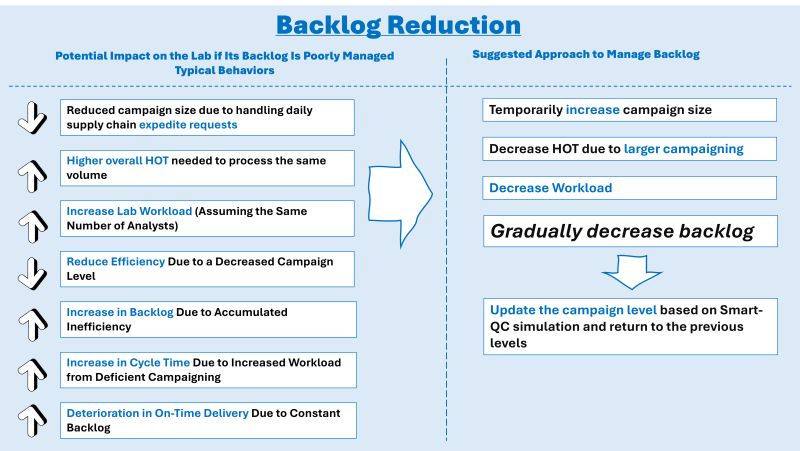
Current Approach & Its Challenges: The common strategy during lab backlog situations involves daily meetings between Supply Chain and the labs to prioritize and release specific critical manufacturing lot. While this may yield short-term gains (i.e., urgent lot to be released), it introduces significant issues:
- ✅ Increased operational stress, raising the risk of human error.
- ✅ Frequent reprioritization disrupts planned workflows and prevents efficient campaigning.
- ✅ Suboptimal equipment and resource utilization, reducing overall lab throughput.
- ✅ Counterproductive long-term effect, where backlog grows instead of shrinking due to inefficiencies introduced by constant reshuffling.
Strategic Flaw: The key flaw in the current model is that it sacrifices system efficiency for perceived responsiveness. In reality, this undermines both people and equipment performance during critical periods. Proposed Alternative Strategy: Though counterintuitive, a more effective strategy is to optimize for sustained throughput rather than immediate lot releases. This can be done through:
- Allowing campaign-based operation: Enable labs to group and process similar tests in larger, more efficient batches.
- Accepting short-term delays: Take a calculated “hit” in the first few days without pushing for daily lot releases.
- Focusing on throughput efficiency: Improved scheduling, reduced changeovers, and better use of instrumentation and personnel.
- Reducing variability and stress: Providing labs with operational autonomy and clarity improves morale and minimizes mistakes.
Expected Results:
- ✅ Gradual and consistent reduction of backlog.
- ✅ Higher lab efficiency and resource utilization.
- ✅ Fewer errors and rework due to reduced stress.
- ✅ Sustainable balance between critical lot management and overall flow.
Preventive Measures:
While the labs may not always see incoming volume early enough, proactive backlog management includes: - ✅ Improved forecasting from upstream partners.
- ✅ Early warning indicators (e.g., WIP trends, scheduling delays).
- ✅ Preemptive action plans triggered before backlog thresholds are reached.