
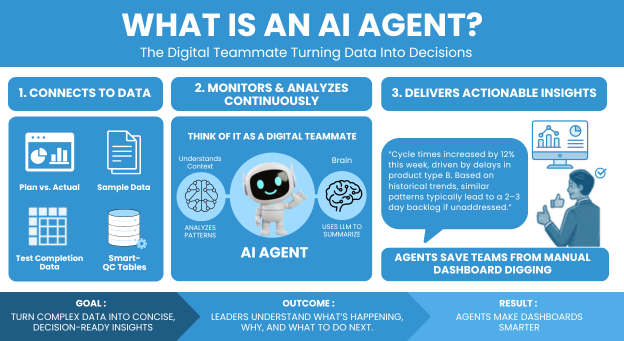
AI Agents are quickly becoming a powerful way to turn data into decisions, but what exactly is an “agent”?
Lets explain and give an example
Think of an agent as a digital teammate. It doesn’t just display data it understands context, analyzes patterns, and delivers clear, actionable insights using AI.
What does an agent do?
An agent connects to structured data (like Smart-QC tables), continuously monitors performance, and uses an LLM to summarize what matters most hence saving teams from manually digging through dashboards.
Purpose
The goal is simple: Turn complex data into concise, decision-ready insights for faster, smarter actions.
Smart-QC Example: Cycle Time Trends Agent
Imagine an agent trained on sample and test completion data, including delays and plan vs. actual performance.
Instead of reviewing multiple reports, the agent can:
– Summarize overall cycle time performance
– Highlight delays and bottlenecks
– Compare actual vs. planned timelines
– Use historical patterns to predict risks for current samples
Output might look like:
“Cycle times increased by 12% this week, driven by delays in product type B. Based on historical trends, similar patterns typically lead to a 2–3 day backlog if unaddressed.”
The result?
Leaders don’t just see data, they understand what’s happening, why it matters, and what to do next.
AI agents aren’t replacing Smart-QC’s dashboards, they’re making them smarter.
Contact us to explore how an agent can transform their data workflows. this last line should be beter