
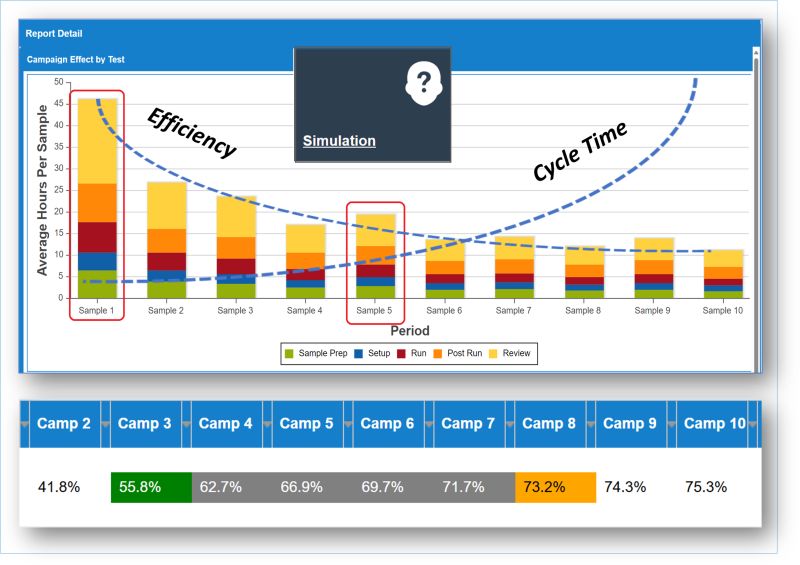
Customers often ask us: Are We Campaigning Too Aggressively or Under-Campaigning and Losing Efficiency?
Using Smart-QC, this assessment is automated, but it’s still valuable to understand the fundamentals of campaigning to guide decision-making.
Campaigning is a balancing act. When done too aggressively, it may increase cycle time with only marginal gains in efficiency. Delaying the start of testing for the sake of accumulating more samples postpones feedback to manufacturing, which can be risky. If issues are identified during testing, this delay may jeopardize upcoming batches.
Conversely, campaigning too early leads to inefficient runs. This creates a backlog in the lab, contributing to increased sample volume and inadvertently encouraging more campaigning—a feedback loop that can spiral out of control.
The art of campaigning lies in finding the sweet spot between these two extremes. Several factors must be considered:
✔ Cycle time
✔ Resource efficiency
✔ Retest rates
✔ Criticality of rapid feedback to manufacturing
✔ Test attributes like preparation/setup time vs. incremental time for additional samples
A useful metric is the ratio between the incremental time of processing the second sample onward versus the time taken for the first sample.
✔ If the incremental time is small compared to the initial preparation and setup, this suggests high reward from campaigning, batching more samples saves time and resources.
✔ If the incremental time is not significantly smaller, then the benefits of campaigning diminish.
Ultimately, an effective campaign strategy should optimize lab efficiency while ensuring timely and reliable feedback to manufacturing and favorable cycle time performance.