
Smart QC Scheduling: A Practical Approach to Complex Lab Operations
Introduction to Smart QC Scheduling
Smart QC scheduling plays a critical role in modern pharmaceutical and biotechnology laboratories where testing processes involve multiple dependencies, specialized analysts, and regulated procedures. Unlike traditional scheduling systems, laboratory workflows must coordinate people, equipment, and analytical processes simultaneously.
Managing these variables manually often leads to delays, inefficient resource utilization, and operational stress for laboratory teams. When tests involve multiple stages, verification requirements, and equipment constraints, even small scheduling conflicts can disrupt laboratory throughput.
To address these challenges, organizations increasingly rely on smart QC scheduling solutions that automate complex scheduling decisions and maintain operational efficiency.
Multi-Day and Multi-Analyst Coordination
Many analytical procedures span multiple days and require contributions from different analysts. For example, one analyst may perform sample preparation while another conducts instrument analysis or reviews results.
This workflow introduces scheduling dependencies that must be carefully coordinated. Analysts may have different shifts, availability windows, or expertise levels. If these factors are not aligned, tests may experience delays between stages.
Effective smart QC scheduling ensures that each stage of a multi-day test is planned in advance so that analysts are available when needed and laboratory resources remain fully utilized.
Equipment and Environment Dependencies
Certain laboratory tests require specific instruments, environmental conditions, or dedicated laboratory spaces. These requirements create scheduling constraints when multiple tests compete for the same equipment.
For example, chromatographic analysis or microbiological testing may require instruments that are shared across teams. If scheduling conflicts occur, testing workflows may stall while analysts wait for equipment availability.
An intelligent smart QC scheduling system accounts for equipment dependencies and prevents scheduling conflicts before they occur, ensuring that instruments and laboratory environments are used efficiently.
Managing Test Dependencies and Sequences
Laboratory testing frequently involves structured sequences where one test must be completed before another begins. These dependencies can include microbial testing sequences, stability studies, or multi-stage analytical workflows.
In these situations, scheduling must go beyond assigning tasks to available time slots. Instead, the system must recognize relationships between tests and ensure that each stage occurs in the correct order.
Using smart QC scheduling, laboratories can automatically enforce these dependency rules while maintaining efficient workflow planning.
Handling Priority and Quick Turnaround Tests
Quality control laboratories often receive urgent samples that require immediate analysis. These quick turnaround tests must be prioritized to support manufacturing timelines or regulatory deadlines.
Traditional scheduling approaches struggle to accommodate these sudden priority changes without disrupting existing plans. Analysts may be forced to pause ongoing tasks or repeatedly adjust schedules.
By using smart QC scheduling, laboratories can dynamically reprioritize tasks while minimizing disruptions to overall operations.
Analyst Skill Matching and Workforce Planning
Assigning laboratory tasks requires careful consideration of analyst qualifications and expertise. Certain tests require specialized training or regulatory authorization, meaning that not every analyst can perform every procedure.
In addition to technical expertise, scheduling must consider analyst shift timing, workload balance, and task handoffs between shifts.
A well-designed smart QC scheduling approach ensures that tasks are assigned to analysts with the correct skills while maintaining fair workload distribution across the laboratory team.
Cross-Team Coordination in Laboratory Workflows
Many laboratory workflows involve collaboration between multiple analytical teams. For example, testing processes may require coordination between dissolution testing teams, chromatography specialists, and microbiology analysts.
When these teams operate independently, delays in one area can disrupt downstream testing activities. Coordinating schedules across teams therefore becomes essential to maintaining consistent laboratory throughput.
Through smart QC scheduling, laboratories can synchronize team activities and ensure that testing stages across departments remain aligned.
How Smart QC Scheduling Improves Laboratory Efficiency
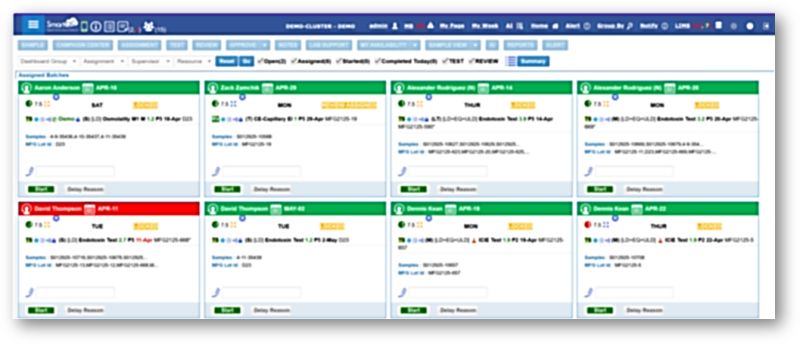
Modern laboratory scheduling platforms such as SmartQC introduce intelligent automation to address the operational complexity of quality control laboratories.
These systems evaluate multiple factors simultaneously, including analyst availability, equipment capacity, testing dependencies, and priority requirements.
Smart QC scheduling solutions provide several key advantages:
- Automated scheduling based on laboratory rules and constraints
- Real-time adjustments when priorities or workloads change
- Improved alignment between analysts, equipment, and testing workflows
- Greater transparency across laboratory operations
By implementing intelligent scheduling tools, laboratories can reduce delays, improve resource utilization, and maintain regulatory compliance.
Ultimately, smart QC scheduling allows life sciences organizations to manage complex laboratory operations more efficiently while supporting consistent quality standards.
To learn how intelligent quality and compliance platforms can support your laboratory operations, Contact Us at cResults. Our solutions such as Smart-QC, Smart-QA, and Smart-FDA help life sciences teams streamline quality management, improve scheduling efficiency, and maintain regulatory compliance.